



What Is Bone Inlay Furniture? The Complete Guide to This Timeless Craft
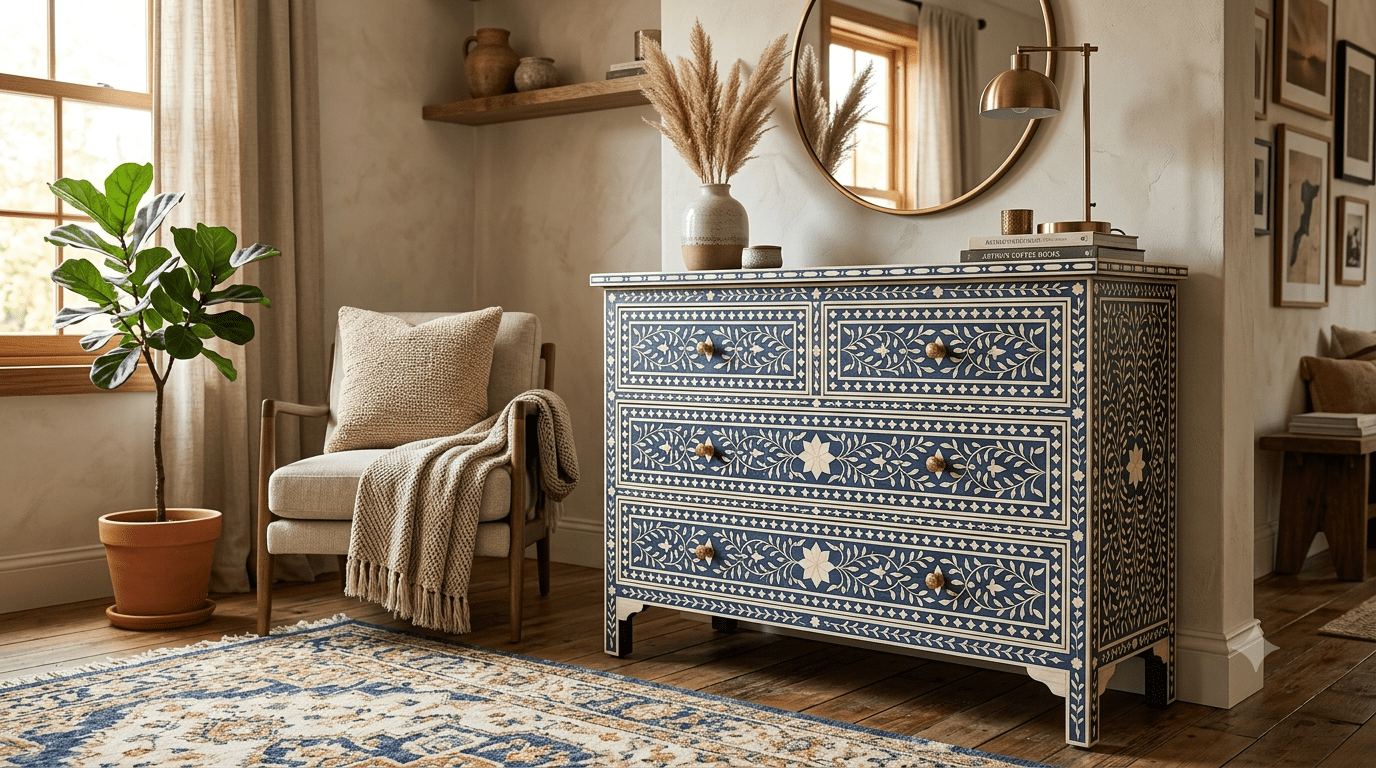
If you’ve ever seen a chest of drawers with an intricate geometric pattern that seems almost too precise to be made by hand, there’s a good chance you were looking at bone inlay furniture. It’s a craft with centuries of history, a deeply personal making process, and a visual impact that no mass-produced piece can replicate. This guide explains exactly what bone inlay furniture is, how it’s made, what makes it worth investing in, and how to bring it into your home.
The Origins of Bone Inlay: A Rajasthani Heritage
Bone inlay is a traditional craft that originated in Rajasthan, India — particularly in the city of Udaipur, which remains its most celebrated centre of production to this day. For generations, skilled artisans known as karigar have passed the technique from father to son, refining the craft with each generation. What began as decorative furniture for Rajput royalty and Mughal nobles has evolved into one of India’s most sought-after furniture exports, prized by interior designers and luxury homeowners from London to Los Angeles.
Why Udaipur Is the Home of Inlay Craftsmanship
The City of Lakes has long been a centre of artisan culture. Udaipur’s workshops — many of them family-run for three or four generations — combine ancient hand techniques with a deep understanding of international design trends. When you buy from a maker like VikisArts, based in Udaipur, you are buying directly from that source of expertise, with none of the quality compromise that comes from mass production.
What Exactly Is Bone Inlay Furniture?
Bone inlay is a decorative technique in which small, precisely cut pieces of bone are set into a wooden frame and filled with resin, then sanded and polished to create a smooth, flat surface. The result is a piece of furniture whose entire visible surface is covered in a detailed repeating pattern — floral, geometric, abstract, or a combination — with no raised edges and no visible seams.
What Kind of Bone Is Used?
Traditionally, camel bone was the primary material used in inlay work, valued for its density, smooth texture, and creamy white finish. Today, many Udaipur craftspeople also use buffalo bone and ethically sourced bovine bone — all of it a by-product of the food industry, making the practice sustainable rather than extractive. The bone is cleaned, bleached, and cut into thousands of individual pieces, each one shaped by hand to fit its exact position in the pattern.
VikisArts uses premium quality bone in all its pieces, ensuring a consistent tone and finish that ages beautifully over time.
The Role of Resin and Wood
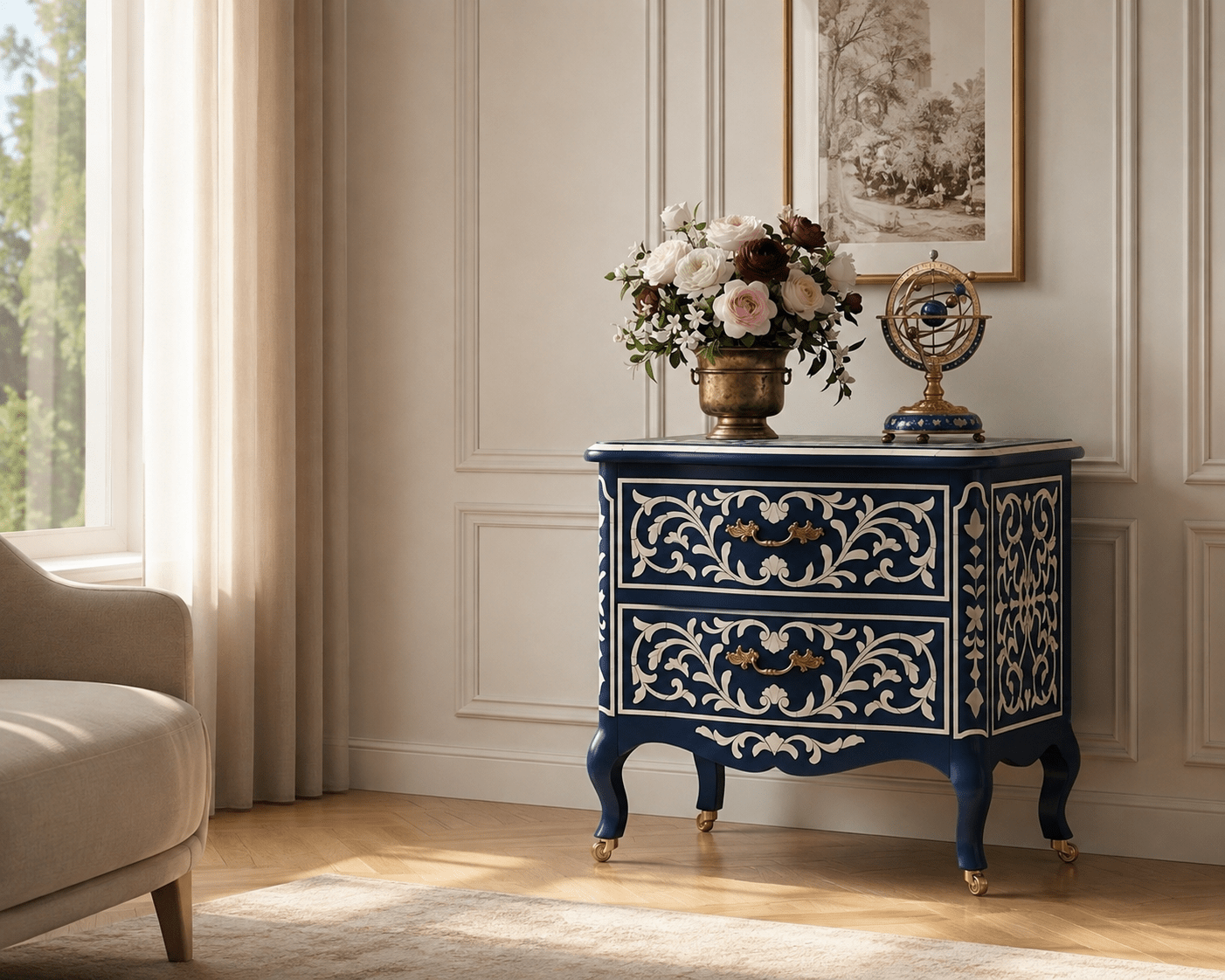
The base structure of a bone inlay piece is almost always mango wood — a dense, durable hardwood abundant in Rajasthan and well-suited to the inlay process. Channels are carved into the wood surface by hand, the bone pieces are individually set and secured with a coloured resin (which gives pieces their characteristic background colour — navy, emerald, blush pink, black, white), and the whole surface is sanded flat and sealed. The resin serves both as adhesive and as the colour story of the piece.
How Bone Inlay Furniture Is Made: Step by Step
Understanding the making process is key to understanding the price point and the value. This is not a production line. It is slow, precise, deeply skilled work.
Step 1 — Pattern Design
Every piece begins with a pattern. Traditional designs include the floral petal, the geometric star, the chevron, and the arabesque. These are drawn onto the wood surface before any cutting begins.
Step 2 — Wood Carving
Channels matching the exact size of each bone piece are carved into the wood by hand using fine chisels. This alone can take several days for a large piece such as a chest of drawers or a buffet table.
Step 3 — Bone Cutting and Setting
Individual bone pieces — some no larger than a fingernail — are cut with a fine saw, shaped as needed, and set one by one into the carved channels. A single bone inlay coffee table may contain thousands of individual bone pieces.
Step 4 — Resin Fill and Finishing
Coloured resin is poured over the surface to fill the gaps between bone pieces. Once cured, the piece is hand-sanded through progressively finer grits until the surface is perfectly smooth. A final lacquer or wax coat seals the work.
What Makes Bone Inlay Different from Mother of Pearl?
This is one of the most common questions buyers ask. Bone inlay and mother of pearl inlay are both traditional Rajasthani techniques, but they are distinct materials with different aesthetics.
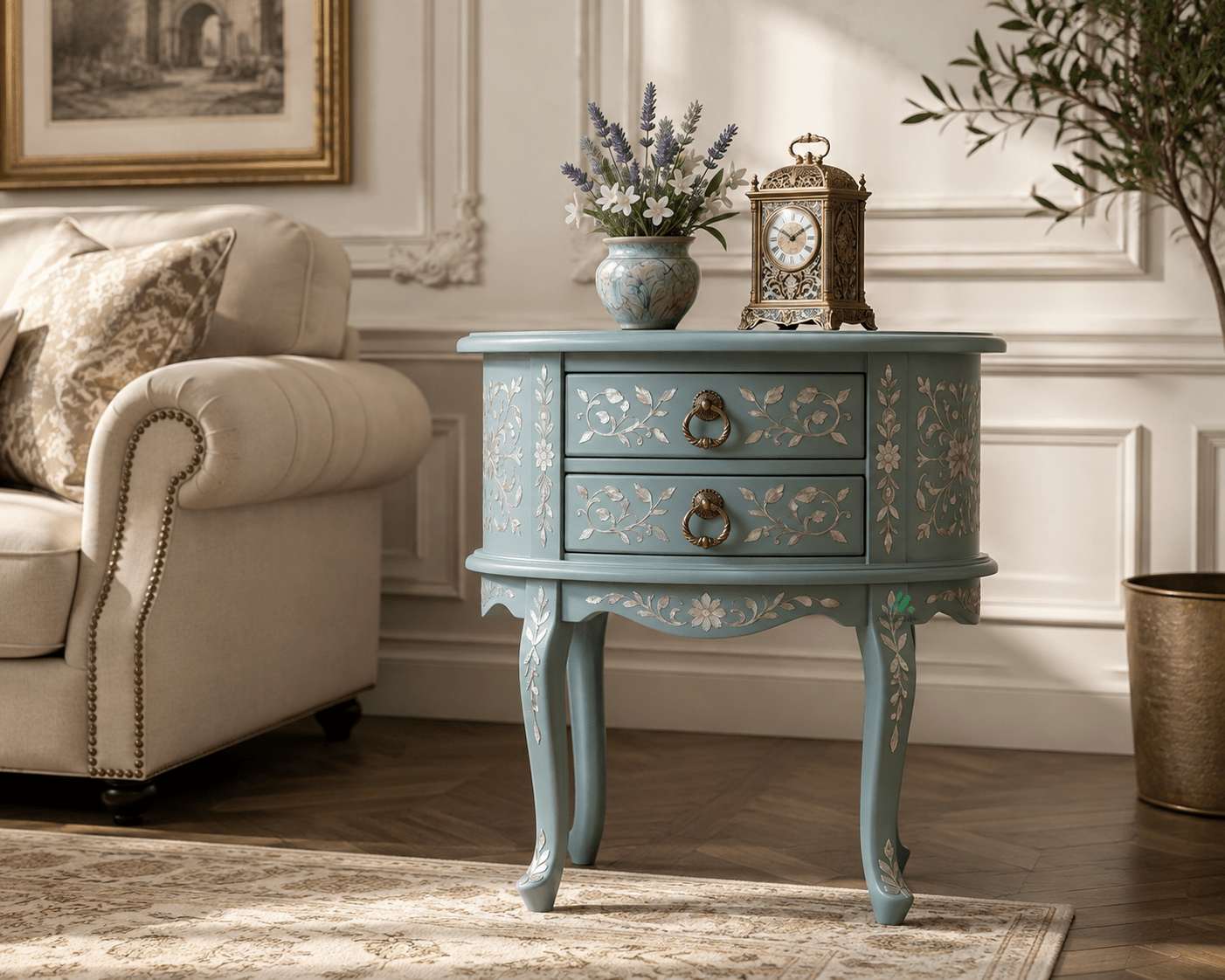
Bone has a matte, warm white finish and a solid, opaque appearance. Mother of pearl — cut from the inner layer of oyster shells — has a lustrous, iridescent shimmer that changes with the light. Both are equally labour-intensive to produce. Bone inlay tends to suit more structured, bold patterns; mother of pearl suits lighter, more luminous spaces.
VikisArts produces both. If you’d like to compare the two in more detail, see our full guide: Bone Inlay vs Mother of Pearl →
Popular Bone Inlay Furniture Pieces and How to Use Them
Bone inlay works across virtually every furniture category, but some pieces have become iconic in the interior design world.
Bone Inlay Console Tables
The console table is perhaps the most popular starting point for buyers new to inlay furniture. A bone inlay console table immediately establishes the personality of a room. VikisArts’ console tables are available in a wide range of colours and patterns. View bone inlay console tables →
Bone Inlay Bedside Tables
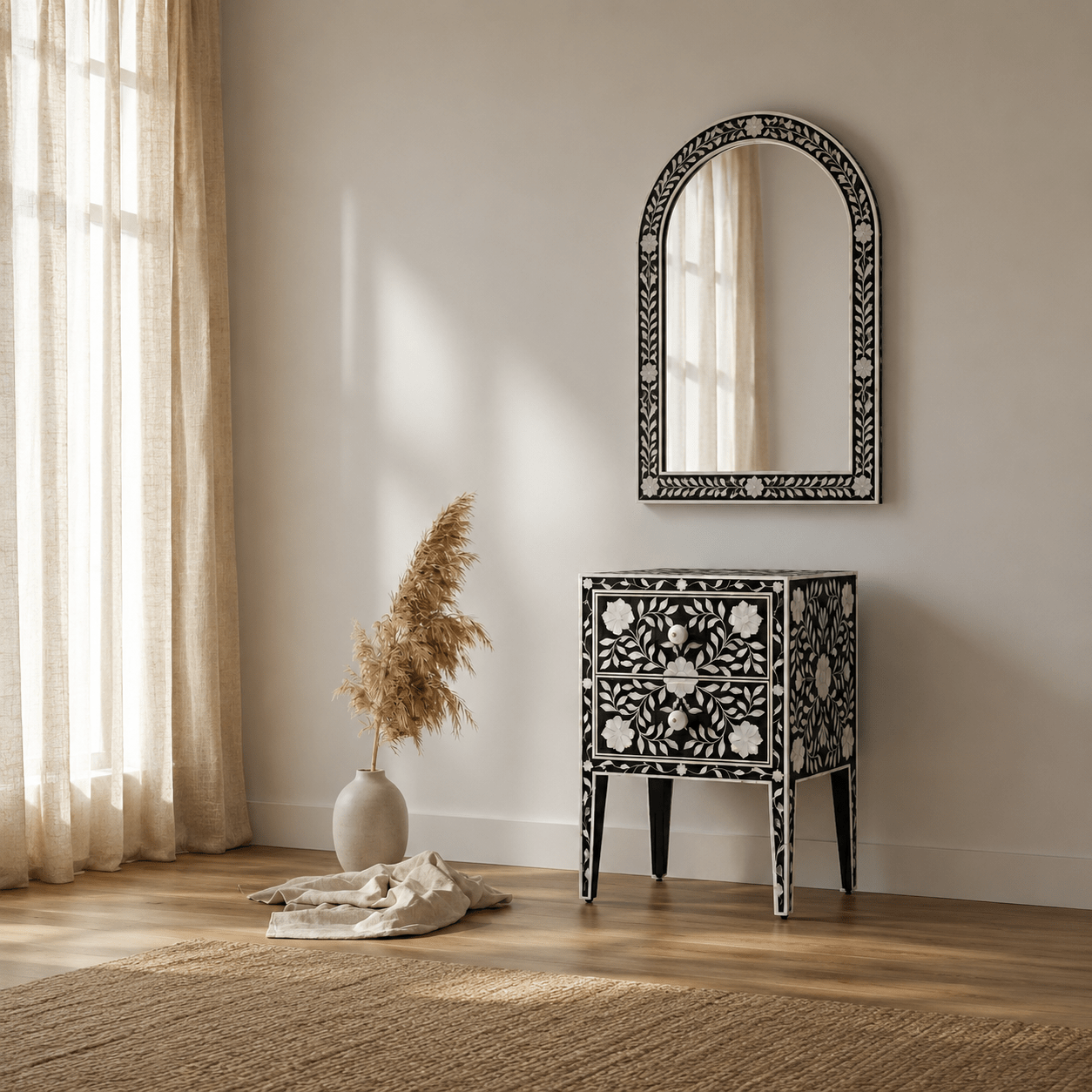
A pair of matching bone inlay bedside tables transforms a bedroom from ordinary to extraordinary. The compact scale makes inlay particularly effective — the pattern is visible at close range and the piece becomes a focal point in its own right. Explore bedside tables →
Bone Inlay Chest of Drawers
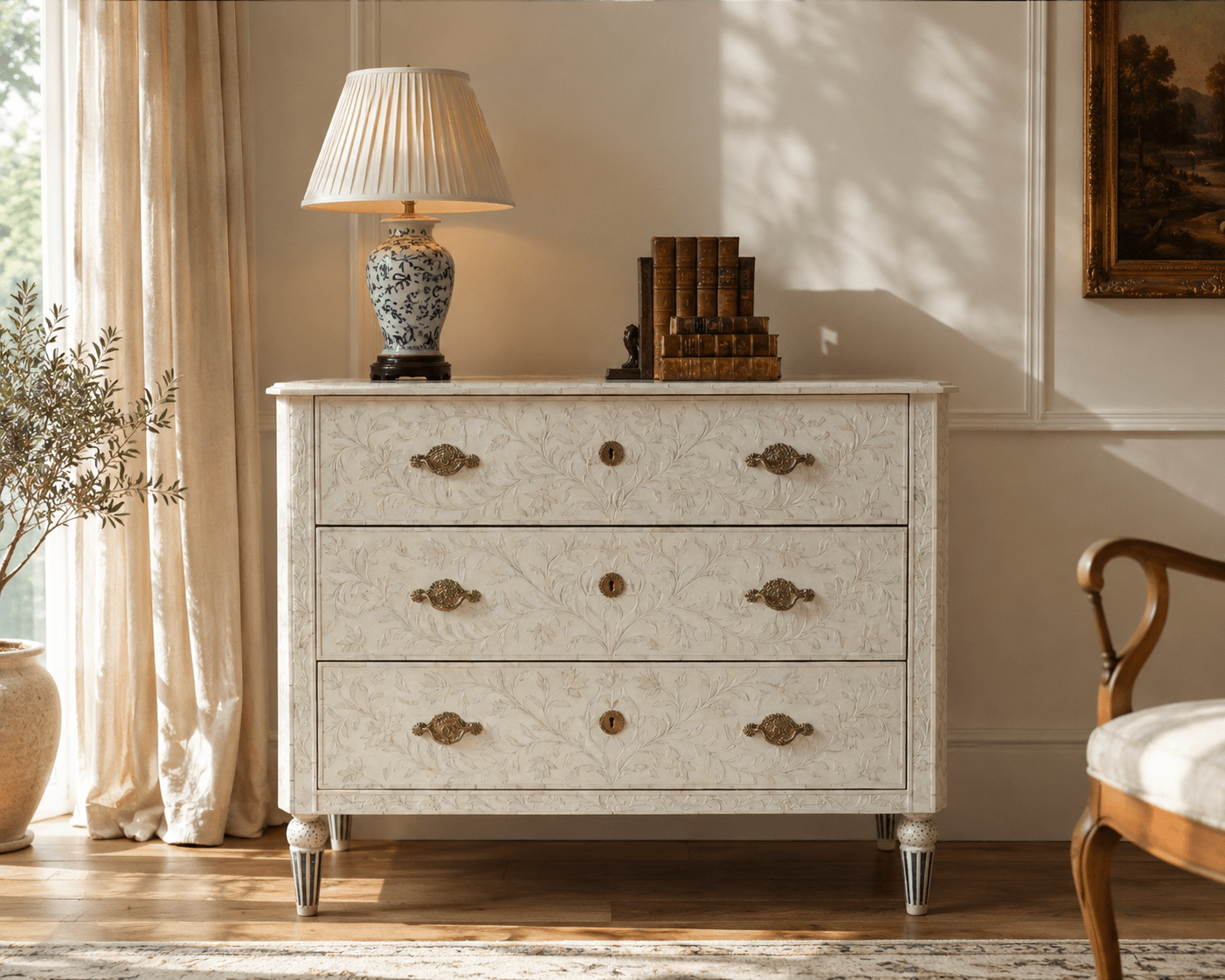
For maximum visual impact, a bone inlay chest of drawers is unmatched. The large surface area allows the full complexity of the pattern to be appreciated. These pieces work as bedroom statement furniture, living room sideboards, or hallway storage. Shop chest of drawers →
Coffee Tables, Bar Cabinets, and More
VikisArts also produces bone inlay coffee tables, bar cabinets, buffet tables, mirror frames, desks, and decorative boxes and trays — making it possible to build a coherent inlay-themed interior across multiple rooms.
Caring for Bone Inlay Furniture
Bone inlay furniture is more durable than it looks, but it rewards proper care. Use a soft, dry cloth for regular dusting. Avoid harsh chemical cleaners. Keep pieces out of direct sunlight for prolonged periods. With basic care, a well-made piece will last for decades. See our full care guide →
Is Bone Inlay Furniture Worth the Investment?
A genuine bone inlay piece represents hundreds of hours of skilled artisan labour, premium materials, and a making tradition with deep cultural roots. Unlike flat-pack furniture or machine-printed decor, bone inlay furniture does not depreciate the way mass-produced pieces do. Many buyers report that their VikisArts pieces become the most commented-on items in their home — and the most treasured over time.
Frequently Asked Questions
What is bone inlay furniture made of?
Is bone inlay furniture ethically made?
Yes. The bone used is a by-product of the food industry — no animals are sourced specifically for their bone. Reputable makers like VikisArts use ethically sourced materials and employ skilled local artisans at fair wages.
How long does it take to make a bone inlay piece?
Can bone inlay furniture be shipped internationally?
What is the difference between bone inlay and wood inlay?
Bone inlay uses cut pieces of animal bone set into carved channels in a wood base. Wood inlay uses pieces of contrasting wood veneers instead. Bone inlay has a more striking, high-contrast appearance; wooden inlay tends to have a warmer, more organic look.
Add a review
Your email address will not be published. Required fields are marked *